


———
UPDATE: This position has been filled as of January 2026.
———
Project Description
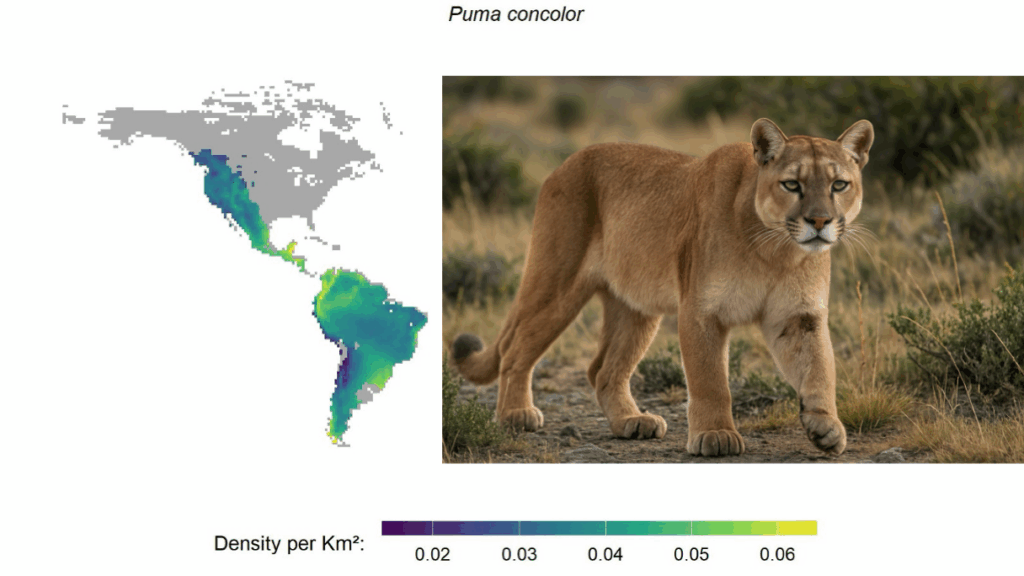
Understanding species abundance patterns is essential to addressing fundamental questions in macroecology and biogeography, specifically about community organisation and ecosystem energetics. However, research in this area is often hindered by limited data, especially when investigating broad biogeographical patterns. Despite ongoing efforts to compile large species abundance datasets, the data remain sparse across space, time, and taxa. A key challenge, therefore, is to expand the available information on species abundances to support ecological research.
To address this issue, novel modelling approaches can complement traditional empirical assessments of species abundance. These frameworks use existing empirical data to fit predictive models based on ecological factors influencing population size—such as species traits (e.g., body mass and behaviour) and environmental variables (e.g., ecosystem productivity and seasonality). A robust modelling framework can help predict species abundance across diverse environmental conditions and taxa, filling critical gaps in empirical databases.
To address this challenge, we are offering a PhD studentship focused on developing advanced modelling frameworks to estimate and predict species abundance. The project will leverage existing datasets on species abundance, traits, and environmental variables to build and validate predictive models. This framework will ultimately serve as a tool for investigating specific ecological and biogeographical questions.
Requirements
- BSc/MSc in biostatistics, mathematics, or physics. Prior exposure to ecology, biology, or environmental sciences, however, is desirable.
- Strong foundation in statistical modelling, ideally with experience in machine/deep learning approaches.
- Proficiency in R (and/or Matlab or Julia).
- Experience in GIS is an asset, but not mandatory.
- Ability to work collaboratively, share ideas, and engage in academic networking.
- Good writing skills and fluency in English.
What We Offer:
- Duration & Scholarship: A 4-year FPI position with a salary of approximately €30,000 per year, plus 31.4% for social security coverage.
- Supervision: Joint supervision by Miguel B. Araújo (MNCN-CSIC), Babak Naimi (University of Utrecht), and Luis Camacho (MNCN-CSIC).
- Research Environment: Integration into vibrant international research groups at MNCN-CSIC (Madrid, Spain) and University of Utrecht (Utretch, Netherlands). See Araújo and Naimi lab pages for more details.
- Funding: Fully supported research project through ongoing grant at MNCN.
Application Process:
- Send your application to Salvador Herrando Pérez at “salherra” [at] gmail [dot] as soon as possible. This call will remain open until a suitable candidate is recruited.
- Application Materials:
CV (max. 5 pages).
Cover letter detailing your interest in the PhD position.
Contact details for two referees who can provide references on your past work.
Email subject: “PhD Position in Species Abundance Modelling”