


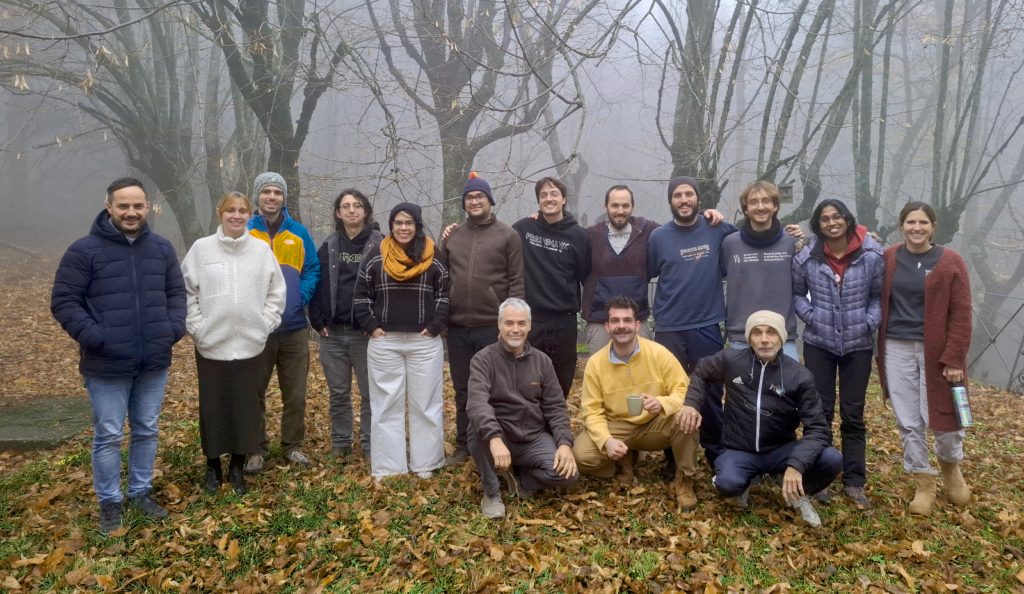
On 9–10 December 2025, the Araújo Lab met at the El Ventorrillo field station in the Sierra de Guadarrama (Spain) for a two-day scientific retreat. The meeting combined research talks, round tables, and informal discussions in a relaxed mountain setting.
The first day featured a presentation on suitable habitats under habitat loss by Nicolás Merino Robert, and a talk on methods to infer predation interaction strengths from binary networks by Armand Rausell Moreno. A round table led by Diego Bengochea Paz explored how artificial intelligence can support our research, from early brainstorming to modelling workflows. The day closed with a walk in the woods and short presentations by Diana Buitrago Torres, Ricard Camps and Sónika Leconte, who introduced their ongoing work.
The second day focused on macroecological and modelling challenges, including work by Luis Felipe Camacho Cardenas on the distribution of energy among species and communities, and by Teresa Goicolea Marín on building a scalable species distribution modelling pipeline for multiple species. A final round table led by Shahar Chaikin and Andrés Molina Godoy (academic visitor from the Pontifical University of Chile) examined how to integrate temperature, thermal limits, and abundance data to predict marine fish responses to warming, followed by time dedicated to lab housekeeping and planning future collaborations.
Overall, the retreat provided an excellent opportunity for lab members to share results, refine ideas, and strengthen collaborations in an inspiring environment.