


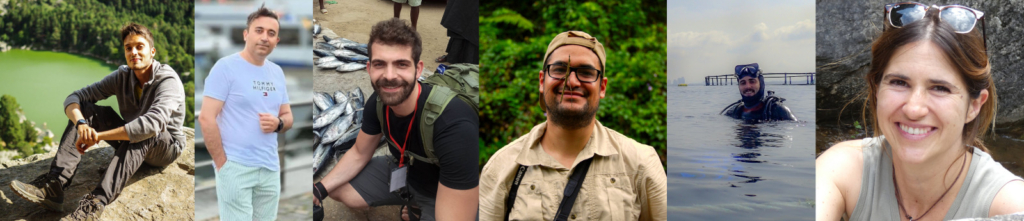
Members of the Araújo Lab will participate in the 12th Biennial Conference of the International Biogeography Society (TIBS 2026), which will take place at Aarhus University, Denmark, from 6 to 10 January 2026. The meeting will bring together biogeographers from around the world to discuss cutting-edge research on the distribution of life in a changing planet, and our group will contribute with a set of talks and posters spanning theory, methods, and applications.
Armand Rausell-Moreno, Núria Galiana and Miguel B. Araújo will present the contribution “Is exclusive competition a realistic expectation at macroecological scales?”. They will introduce a framework to test whether strong competitive interactions can leave detectable signatures in species’ geographic distributions over large spatial extents. Using a European trophic database applied to the Iberian Peninsula, they will identify potential competitors based on diet, body mass and trophic similarity, and then evaluate whether highly similar species tend to exclude each other in space once environmental constraints, dispersal limits, and human impacts are accounted for. This work will help clarify under which conditions competition might shape range limits at macroecological scales.
Our collaborator Babak Naimi (Utrecht University), together with Miguel B. Araújo and Edwin Pos, will present “Illusion of pseudo-absences: a call for non-informative backgrounds in species distribution modelling”. This contribution will critically examine how the choice of pseudo-absences or background points can unintentionally inject structure into species distribution models, thereby biasing parameter estimates, variable importance, and apparent accuracy. The talk will argue for reference samples that are as non-informative as possible in environmental space, and will outline practical strategies to de-inform backgrounds and improve inference so that biological signals, rather than artefacts of sampling design, drive model outcomes.
Georgios Vagenas, Miguel G. Matias and Miguel B. Araújo will present “Beyond land: a framework for modelling aquatic species distributions”. They will propose a multi-stage protocol tailored to freshwater systems that combines hierarchical strategies (global-to-regional versus strictly regional models), alternative spatial constraints (unconstrained versus watershed-constrained extents), and different sets of climatic and hydrological predictors. Using freshwater fish in the Iberian Peninsula as a case study, they will show how model performance responds to these design choices and demonstrate that only by integrating them coherently can aquatic species distribution models achieve robust predictive skill in dendritic river networks.
Luis Camacho and Miguel B. Araújo will contribute the talk “Body mass–abundance relationships reveal uneven global energy distribution across size classes”. This work will present a global analysis of more than ten thousand bird and mammal species to investigate how ecosystem productivity and human pressure influence the relationship between body size, abundance, and energy use. They will show that in more productive and human-impacted systems, the relative abundance of small species tends to decrease, even as species richness increases, implying a redistribution of energy capture across size classes with important consequences for ecosystem functioning.
Shahar Chaikin, Juan David González-Trujillo and Miguel Bastos Araújo will present “Long-term warming reduces fish biomass, but heatwaves shift it”. This contribution will disentangle the effects of long-term ocean warming, interannual variability, and marine heatwaves on marine fish populations, using hundreds of thousands of biomass estimates across major Northern Hemisphere basins. They will show that gradual warming is associated with consistent biomass declines, while short-term thermal anomalies and heatwaves can trigger abrupt redistributions, with losses at warm edges and gains at cold edges of species’ ranges—highlighting the need for adaptive fisheries management and strong climate mitigation.
Finally, Teresa Goicolea, Jennifer Morales-Barbero, Alejandra Zarzo-Arias, Herlander Lima, Virgilio Gómez-Rubio, Miguel B. Araújo and Rubén G. Mateo will showcase the R package sabinaNSDM in their contribution “Spatially-nested hierarchical Species Distribution Models with sabinaNSDM”. They will review the concept of spatially nested hierarchical species distribution models, which combine global-scale and regional-scale components to minimise niche truncation while exploiting fine-resolution predictors, and will introduce sabinaNSDM as a user-friendly tool to implement such workflows. A case study on 200 woody plant species in Spain, under current and future climate scenarios, will illustrate how nested models can improve projections and deliver policy-relevant, fine-scale maps for conservation planning.
Together, these contributions will position the Araújo Lab and collaborators at the forefront of discussions on species interactions, methodological foundations of species distribution modelling, macroecological patterns of energy use, and the effects of climate change on biodiversity at the International Biogeography Society’s Aarhus meeting in 2026.