


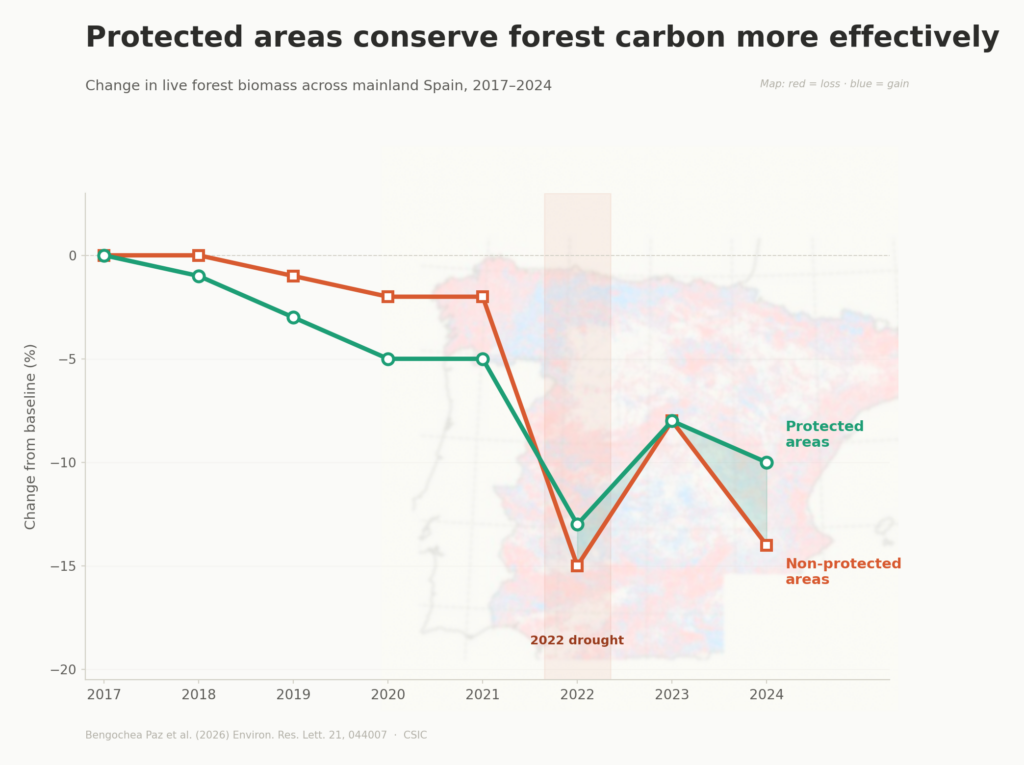
A new study published in Environmental Research Letters shows that protected areas in mainland Spain were more effective than comparable non-protected lands at conserving live forest biomass carbon between 2017 and 2024, even under intensifying drought and wildfire pressure. The research, led by Diego Bengochea Paz, Ana Rey, and Miguel B. Araújo at the National Museum of Natural Sciences (CSIC), and Miguel Ángel Zavala at the University of Alcalá, provides empirical support for the role of protected areas in climate-change mitigation and biodiversity policy, including international targets to expand protected land coverage.
The study addresses a growing debate over whether protected areas in fire-prone landscapes may accumulate high fuel loads and therefore become more vulnerable to severe carbon losses. Using satellite-derived above-ground biomass data and statistical matching methods to compare protected and non-protected sites with similar initial biomass and climate exposure, the authors found that protected areas consistently retained carbon better than their non-protected counterparts.
“Our analysis shows that protected areas in mainland Spain retained live forest biomass carbon better than comparable non-protected lands, even after controlling for initial biomass and climate exposure,” said Diego Bengochea Paz, lead author of the study. “This is important because it suggests that the carbon-conservation advantage of protected areas is not simply a by-product of where they are located, but is associated with their protection and management status.”
Key findings
Protected areas showed higher carbon conservation performance in 70% of biomass-matched comparisons.
- The advantage remained under stricter controls, with protected areas outperforming comparable non-protected areas in 59% of comparisons after accounting for both initial biomass and climate conditions.
- National Parks performed especially well, showing better biomass conservation in 85% of biomass-matched comparisons.
- Protection status itself mattered: the carbon-conservation benefit of protected areas could not be explained only by their location in more favourable or less exposed environments.
The findings provide an important counterpoint to recent claims that protected areas may function as wildfire hotspots simply because they contain more biomass or experience lower levels of intervention. The authors argue that comparisons based only on fire occurrence or burned area can be misleading if they do not control for pre-existing differences in fuel loads and climate exposure.
“There has been growing concern that protected areas in fire-prone landscapes might become liabilities for carbon conservation,” said Miguel B. Araújo, senior author of the study. “Our results indicate the opposite: when protected areas are compared fairly with similar non-protected landscapes, they tend to conserve biomass carbon more effectively. That makes them an important part of climate-mitigation and land-management strategies, especially in drought- and fire-sensitive regions.”
Implications for fire and land management
Rather than treating protection as equivalent to passive non-intervention, the study highlights the importance of combining conservation with active landscape management in fire-prone systems. In Mediterranean Europe, where climate-driven drought, heat extremes and wildfire increasingly threaten forest carbon stocks, protected areas can remain effective carbon reservoirs when embedded within broader strategies for fire-regime management and ecological resilience.
These strategies may include:
- creating pyrodiverse mosaics through selective thinning and prescribed burning,
- establishing strategically placed green firebreaks, and
- promoting herbivory by wild or extensively managed large mammals to help reduce fuel loads naturally.
The authors argue that the challenge is not whether protected areas should exist in fire-prone regions, but how they should be managed to stabilize carbon stocks under a warming and drying climate.
About the study
The research analysed above-ground biomass trends across mainland Spain at high spatial resolution using data derived from Sentinel-2 imagery, airborne LiDAR and forest inventory sources. The authors then used statistical sample matching to compare protected and non-protected areas under progressively stricter scenarios, allowing them to isolate the contribution of protection status from differences in starting biomass and environmental conditions.
The study focused on Spain’s temperate and Mediterranean forests, including many rear-edge systems that are especially vulnerable to climate stress, drought and large wildfires. Its conclusions are directly relevant to ongoing debates about the climate value of protected areas in southern Europe and other fire-prone regions.
Bengochoa, D., Rey, A., Zavala, M.A. & Araújo, M.B. 2026. Protected areas are effective at preserving carbon sink capacity even in fire-prone terrestrial ecosystems. Environmental Research Letters. 21 (4), 044007. doi: 10.1088/1748-9326/ae3783