


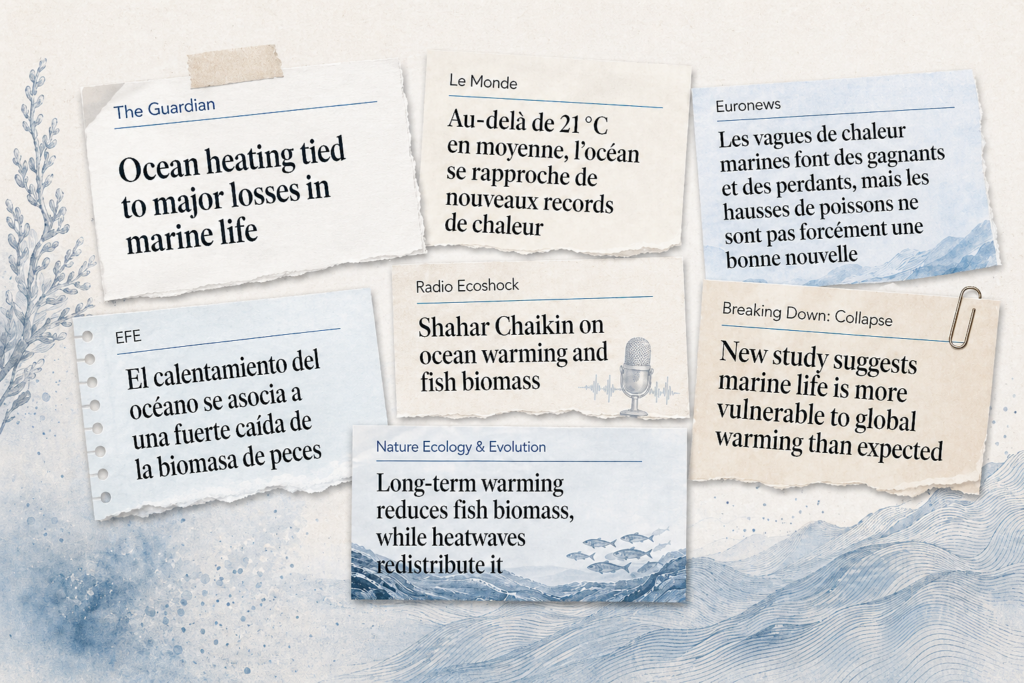
Our recent paper in Nature Ecology & Evolution, “Long-term warming reduces fish biomass, but heatwaves shift it”, has attracted substantial international media attention since its publication on 25 February 2026. The study, led by Shahar Chaikin, with Juan David González-Trujillo and Miguel B. Araújo, analysed 702,037 estimates of biomass change across 33,990 fish populations, covering 1,566 species between 1993 and 2021. Its central result is clear: long-term ocean warming is associated with major declines in fish biomass, with losses reaching up to 19.8% per year in some cases. (doi.org)
The paper also shows why the ecological signal can be difficult to interpret. Marine heatwaves and unusually warm years can generate short-term increases in fish biomass in populations located near the colder edge of a species’ range. At the same time, they can produce sharp losses in populations already living near their warmer thermal limits. These temporary increases may therefore create an illusion of abundance, potentially obscuring the broader decline caused by sustained ocean warming.
This message was picked up by major international outlets. The Guardian reported the study under the headline “Chronic ocean heating fuels ‘staggering’ loss of marine life”, highlighting that fish levels may fall by 7.2% for every 0.1°C of warming per decade, and that warming of the seafloor is strongly linked to biomass loss. (The Guardian) Euronews focused on the apparent paradox that marine heatwaves may create both “winners and losers”, while stressing that short-term increases in some regions should not be interpreted as good news for fisheries or marine ecosystems. (euronews)
The Spanish news agency EFE emphasised the scale of the analysis and its relevance for fisheries management and marine conservation, noting that the study covered the Mediterranean, North Atlantic and North-eastern Pacific and included both commercial and non-commercial fish species. (EFE Noticias) The study was also discussed in Le Monde in the broader context of record ocean temperatures, marine heatwaves and the tropicalisation of the Mediterranean, where Shahar Chaikin warned that temporary local increases in fish biomass may mask a large-scale decline. (Le Monde.fr)
The paper’s reach extended beyond written media. It was featured in the podcast Breaking Down: Collapse, which discussed the result that a 0.1°C rise in temperature is associated with a 7.2% loss in marine life. (shows.acast.com) It was also the subject of a 23-minute interview with Shahar Chaikin on Radio Ecoshock, a programme broadcast by more than 100 radio stations, where the implications for fisheries, climate change and international management were discussed in detail. (ecoshock.org)
The attention received by the paper reflects a broader public concern: ocean warming is no longer an abstract climate signal, but a measurable biological pressure affecting marine populations, fisheries and food security. The study reinforces the need for fisheries management to distinguish between transient gains and long-term decline. In a warming ocean, local increases in fish biomass may be real, but they should not be mistaken for sustainable abundance.
At the time of checking, the article had already registered strong online attention, with Nature Ecology & Evolution reporting an Altmetric score of 386. (doi.org) This impact, together with coverage in outlets such as The Guardian, Le Monde, Euronews, EFE, Radio Ecoshock and specialist podcasts, shows that the scientific message has resonated well beyond academia: continued ocean warming is reshaping marine life, and management systems must adapt before temporary signals of abundance lead to long-term ecological and economic losses.