


 For most of their history, biogeography and ecology have worked on the same problem from opposite ends and rarely met in the middle. Biogeography asked why life is distributed as it is across continents and oceans, and answered mostly in terms of climate and history. Ecology asked how species interact — who eats whom, who pollinates whom, who outcompetes whom — and answered mostly at the scale of a single meadow or pond. The interactions that ecologists placed at the centre of their discipline were, for biogeographers, a detail too local to matter at the scale of a map.
This dichotomy was never a conceptual one. It was mainly an issue of data. We simply did not know who interacted with whom across large spatial extents — a gap large enough to have its own name, the Eltonian shortfall. You cannot put interactions on a continental map if you do not know what the interactions are.
In a new Essay in PLOS Biology, we argue that this is changing, and changing fast enough to warrant a name of its own: biotic interactions biogeography. New methods for reconstructing ecological networks across regions, standardised global datasets, and the idea of the metaweb (see our earlier essay in TREE)— the full set of interactions that could occur among the species of a region — now let us ask questions that previously fell into the gap between the two fields.
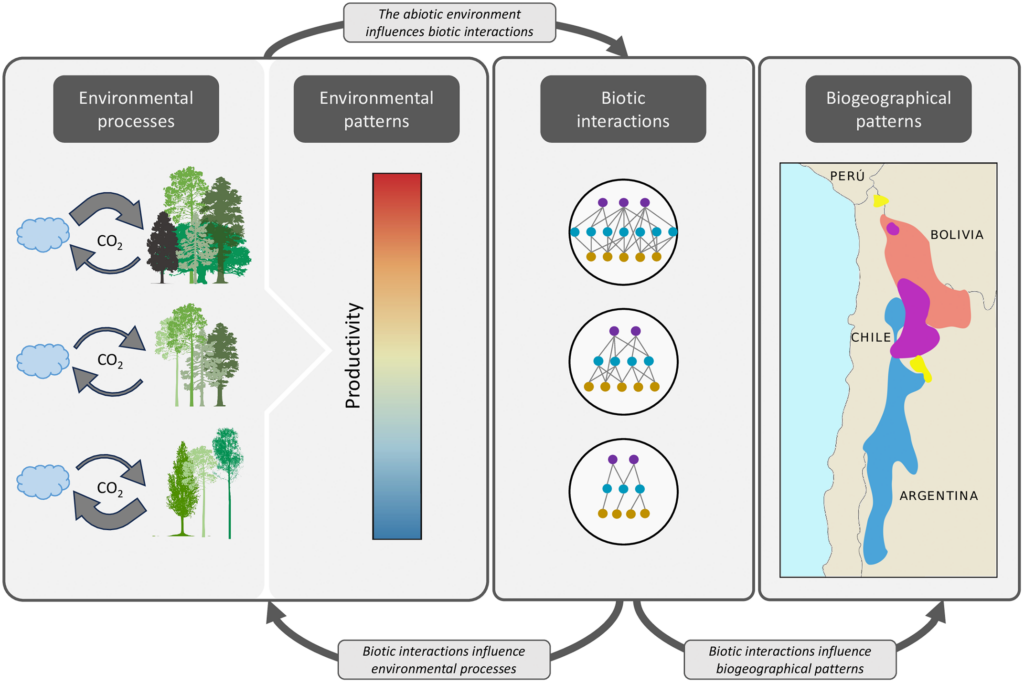
The Essay organises this emerging field around three reciprocal questions. How do biotic interactions shape where species live? How do environmental gradients, in turn, reshape the interactions themselves? And how do those interactions feed back to alter the physical environment — soils, nutrient cycles, water, even climate? None of these arrows points one way. The environment sets the stage for interactions; interactions decide who can persist; and the resulting communities remake the environment that constrains them.
The figure that illustrates this whole argument in a single frame is shown belore. It shows the three-way traffic between the abiotic environment, biotic interactions, and large-scale biodiversity patterns, and it grounds the abstraction in a concrete case: the Liolaemus lizards of South America, one of the most spectacular continental radiations among vertebrates, where closely related species partition niches finely enough to coexist across the same harsh Andean landscapes (see our previous paper in ELE). It is a reminder that the grand patterns on a biogeographer’s map are built, in the end, from the everyday business of species getting along with — or out of the way of — one another.
There is a reason this matters now beyond tidying up the relationship between two disciplines. The interactions are precisely what we strip out when we predict species’ responses to climate change from climate alone. A species does not track temperature in a vacuum; it tracks its prey, its competitors, its mutualists, each of them moving too. If we want predictions worth trusting in a rapidly changing world, the interactions cannot stay in the margins.
The full Essay is open access in PLOS Biology: read it here.