


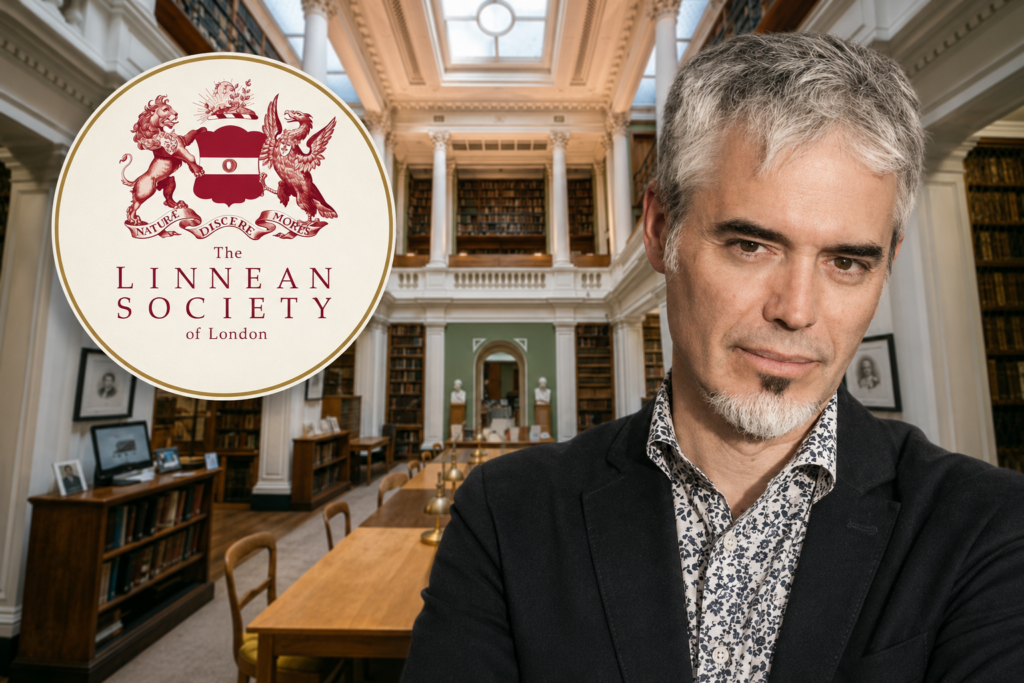
The election recognises his contribution to biodiversity science and connects his work to one of the world’s most historic institutions devoted to the study of nature.
Miguel Bastos Araújo, Research Professor at the Museo Nacional de Ciencias Naturales, Spanish National Research Council (MNCN-CSIC), and Chair of Biodiversity at the University of Évora, has been elected a Fellow of the Linnean Society of London on the 25th of June 2026.
Founded in 1788, the Linnean Society is one of the most historically significant learned societies in the biological sciences. It is closely associated with the development of natural history, taxonomy, systematics, evolution and the modern study of biodiversity. The Society takes its name from Carl Linnaeus, whose collections, library and manuscripts remain central to its scientific and cultural heritage. It was also at a meeting of the Society, in 1858, that the joint papers by Charles Darwin and Alfred Russel Wallace outlining the theory of evolution by natural selection were first read.
Election as a Fellow places Araújo within an international community of scientists, naturalists and scholars committed to understanding, communicating and protecting the natural world. For Araújo, whose work has focused on biogeography, macroecology, biodiversity modelling, climate change impacts and conservation planning, the Fellowship has both professional and symbolic significance.
“I am deeply honoured to have been elected a Fellow of the Linnean Society,” said Araújo. “The Society occupies a unique place in the history of biology. It connects the foundational traditions of natural history and taxonomy with the urgent contemporary challenge of understanding and protecting biodiversity in a rapidly changing world. To become part of that community is both a recognition and a responsibility.”
Araújo’s research has contributed to understanding how species and ecosystems respond to environmental change, particularly climate change, and how this knowledge can inform conservation decisions. His work spans theoretical ecology, global biodiversity modelling and applied conservation planning, with a strong emphasis on translating biodiversity science into tools and evidence for policy.
“The Linnean Society reminds us that the study of nature is not only a scientific enterprise, but also a cultural and civic one,” Araújo added. “At a time when biodiversity loss and climate change are reshaping the living world, institutions that defend rigorous natural history, open scientific exchange and public engagement with nature are more important than ever.”
The Fellowship further strengthens Araújo’s links with international scientific institutions dedicated to biodiversity research and conservation, and reflects the continuing relevance of natural history traditions to contemporary environmental science.
About Miguel Bastos Araújo
His research focuses on biogeography, macroecology, climate change ecology, biodiversity modelling and conservation planning. He has contributed extensively to international biodiversity assessments and to the development of tools for anticipating biodiversity responses to global environmental change. His contributions have been recognised through a range of national and international appointments and distinctions. He is a member of Academia Europaea and the Lisbon Academy of Sciences. In 2026, he was appointed by the President of the Portuguese Republic as one of the five citizens designated to the Council of State for the duration of the presidential mandate. His election as Fellow of the Linnean Society of London adds to this broader trajectory of recognition and is especially meaningful because of the Society’s historic role in the study of natural history, taxonomy, evolution and biodiversity.
About the Linnean Society of London
The Linnean Society of London is a learned society devoted to the study and communication of natural history and the biological sciences. Founded in 1788, it is widely regarded as the world’s oldest active biological society and holds internationally significant collections, including the library, manuscripts and biological specimens of Carl Linnaeus. The Society occupies a distinctive place in the history of biology: in 1858, the joint papers by Charles Darwin and Alfred Russel Wallace outlining the theory of evolution by natural selection were first read at one of its meetings. Today, the Society continues to support science, heritage, education, publications and public engagement, promoting the study and understanding of the natural world across disciplines and audiences.