


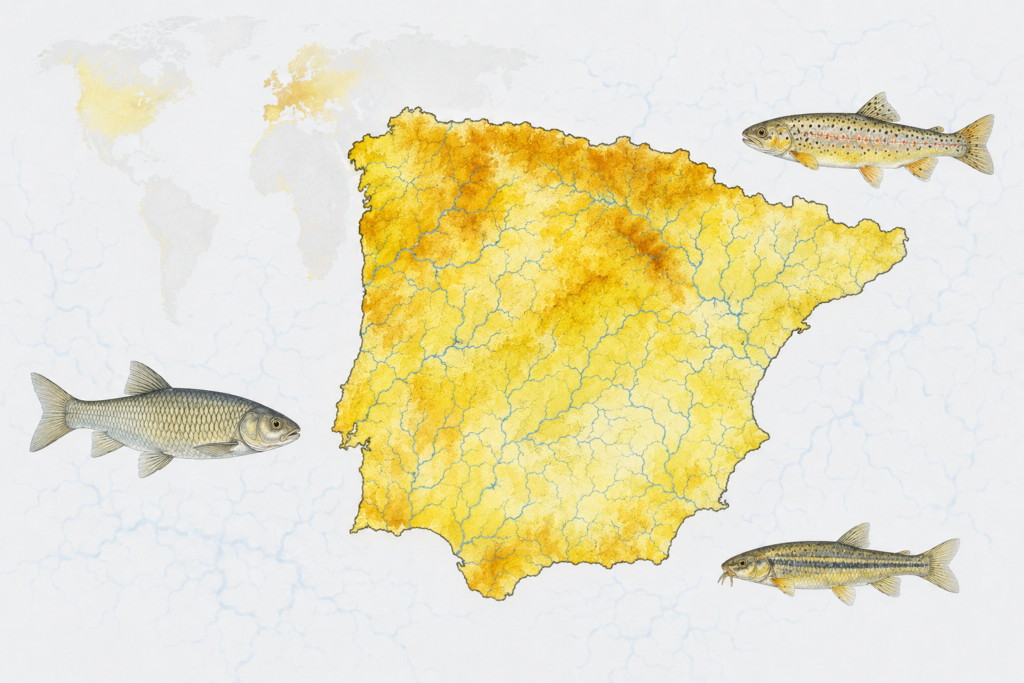
A new study tests how spatial extent, river-network structure and environmental predictors affect species distribution models for freshwater organisms
- The study presents a reproducible workflow for comparing alternative spatial extents and environmental predictors in aquatic species distribution models.
- For 98 Iberian freshwater fishes, relatively broad watershed units provided the best balance between predictive performance, ecological relevance and computational efficiency.
- Information from occurrences beyond the Iberian Peninsula helped reduce niche truncation for widespread species, without assuming that their complete environmental niche had been characterised.
- Within the regional models tested, climatic and hydroclimatic predictors generally performed better than the available hydromorphological predictors, although the latter contributed finer-scale spatial variation.
A new study from our lab, published today in Global Ecology and Biogeography, presents a systematic framework for building and evaluating species distribution models in freshwater systems.
Species distribution models relate observations of species to environmental conditions in order to estimate where suitable conditions occur. Although these models are widely used in ecology and conservation, most methodological development has taken place in terrestrial systems. Freshwater organisms present additional challenges because they occupy branching and spatially constrained hydrographic networks, while the environmental factors associated with their distributions operate across different spatial scales.
Using 98 freshwater fish species from the Iberian Peninsula, Georgios Vagenas, Miguel G. Matias and Miguel Bastos Araújo tested how model results were affected by three key methodological choices: the geographic extent used to train the models, the environmental variables included, and the way information from global and regional distributions was combined.
The analysis compared freshwater ecoregions with three nested watershed levels and evaluated climatic, hydroclimatic and hydromorphological predictor sets. Five modelling algorithms and repeated model runs were used, producing more than 40,000 individual models.
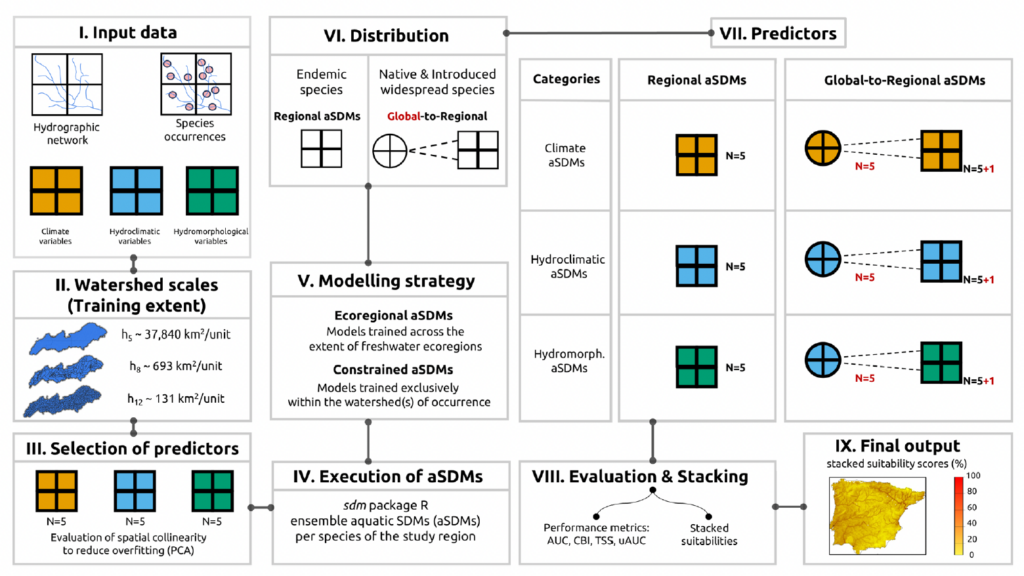
Flowchart illustrates the workflow for aquatic Species Distribution Models (aSDMs), comprising nine sequential stages (i.e., I–IX), from input data preparation, model training, evaluation, and generation of stacked suitability maps.
Finding an appropriate training extent
The spatial extent used to calibrate a species distribution model strongly influenced its performance. In this case study, HydroBASINS level 5 watersheds—covering an average area of approximately 37,800 km²—provided the most parsimonious training extent. Models trained at this level retained high predictive performance while using a more restricted and ecologically meaningful area than entire freshwater ecoregions.
Training models within smaller watersheds generally reduced their predictive capacity, while broader ecoregional extents produced no consistent improvement. The results therefore identify a useful balance for the species and data examined, rather than a universally optimal watershed size for all freshwater applications.
“Freshwater species do not occupy continuous landscapes: they are distributed through branching networks,” explains Georgios Vagenas, who carried out the study as the first chapter of his doctoral research at MNCN-CSIC. “Our aim was to test systematically how the boundaries used to train a model affect its performance, while respecting the spatial structure of river basins.”
Combining global and regional information
For species whose distributions extend beyond the Iberian Peninsula, the researchers first built models using available occurrence records from across their global distributions. The resulting suitability estimates were then incorporated into regional models for Iberia.
This global-to-regional structure was designed to reduce niche truncation—the bias that can arise when a widespread species is modelled using observations from only a limited part of its distribution. The global component was particularly informative for widespread native species, but less so for non-native species.
“Expanding model calibration beyond Iberia does not necessarily recover a species’ entire environmental niche, because distributions may not be in equilibrium with current environmental conditions and available occurrence records may not capture their full geographic or environmental range,” says Miguel Bastos Araújo. “It is, however, a practical way of using more of the available information and reducing one important source of bias in regional studies.”
Environmental information at different scales
Within the regional models examined, climatic and hydroclimatic predictors generally matched or outperformed the available hydromorphological predictors. Climatic variables described comparatively broad and spatially smooth suitability patterns, while variables related to water temperature and streamflow introduced greater regional differentiation. Hydromorphological predictors added more localised spatial variation.
“The patterns recovered by our models are consistent with environmental filtering operating at different spatial scales,” says Miguel G. Matias. “Using a common protocol allowed us to compare the relative contributions of climatic, hydroclimatic and hydromorphological information without conflating those differences with changes in model design.”
These results should not be interpreted as demonstrating a universal causal hierarchy. Predictor performance depends on the variables available, their resolution and the structure of the models. In this study, the hydromorphological variables were landscape-level proxies rather than direct measurements of local water quality or in-stream habitat conditions.
The main contribution of the study is therefore an integrated and reproducible protocol for testing these choices consistently. Although developed with Iberian freshwater fishes, the workflow is structured so that it can be evaluated with other freshwater organisms, including macroinvertebrates and aquatic plants, and in other geographical regions.
The study examines current species distributions and methodological choices in aquatic distribution modelling. It does not project the effects of future climate change.
The data, analytical code and a tutorial implementing the workflow are publicly available.
Reference
Vagenas, G., Matias, M. G. & Araújo, M. B. (2026). Hierarchical Modelling of Aquatic Species Distributions. Global Ecology and Biogeography, 35, e70301. https://doi.org/10.1111/geb.70301