


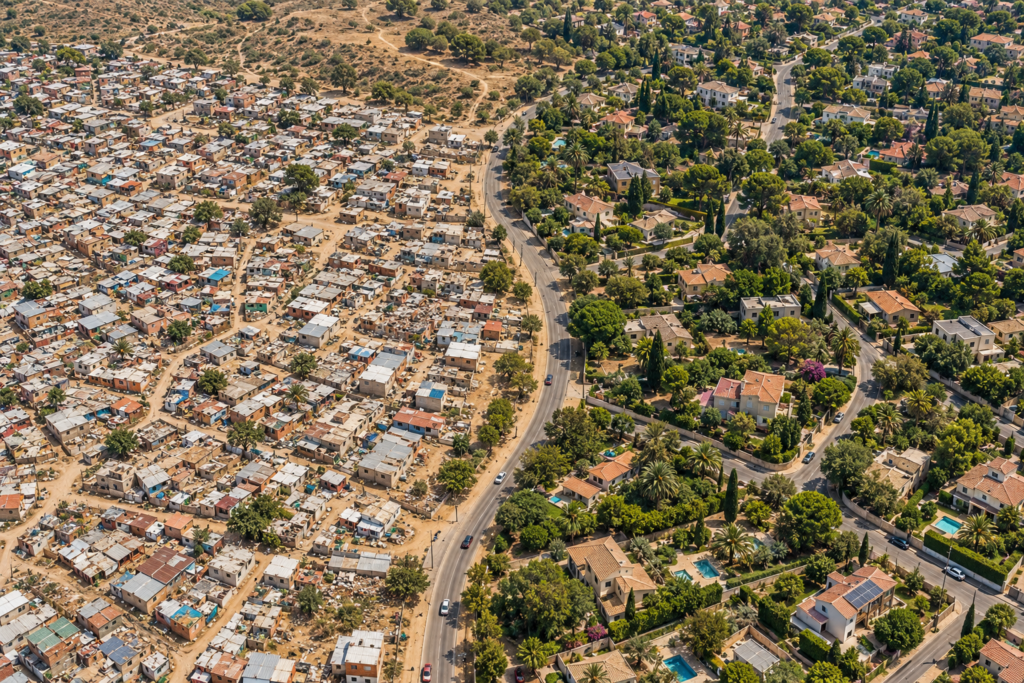
A study of 380 municipalities finds weaker income gaps in vegetation under historically left leaning governments while density and aridity dominate citywide vegetation levels
Wealthier neighbourhoods tend to contain more trees and shrubs per resident, but the size of this inequality is associated with a city’s political history. A study across mainland Spain finds that the income gap in urban vegetation tends to be smaller in municipalities with a history of left-leaning governments. Political history showed no detectable statistical association with vegetation per resident at the municipal scale.
Published in Urban Forestry & Urban Greening, the research combines 44 years of municipal electoral records, covering 1979–2023, with high-resolution vegetation maps, income data and information on climate and population density. The analysis covers 380 municipalities and 19,252 census tracts across 75 urban areas.
“A citywide average can conceal large inequalities between neighbourhoods. Our analysis shows that political history is associated with the size of those income gaps, even though it does not explain how much vegetation a municipality holds overall,” says Diego Bengochea Paz, lead author of the study.
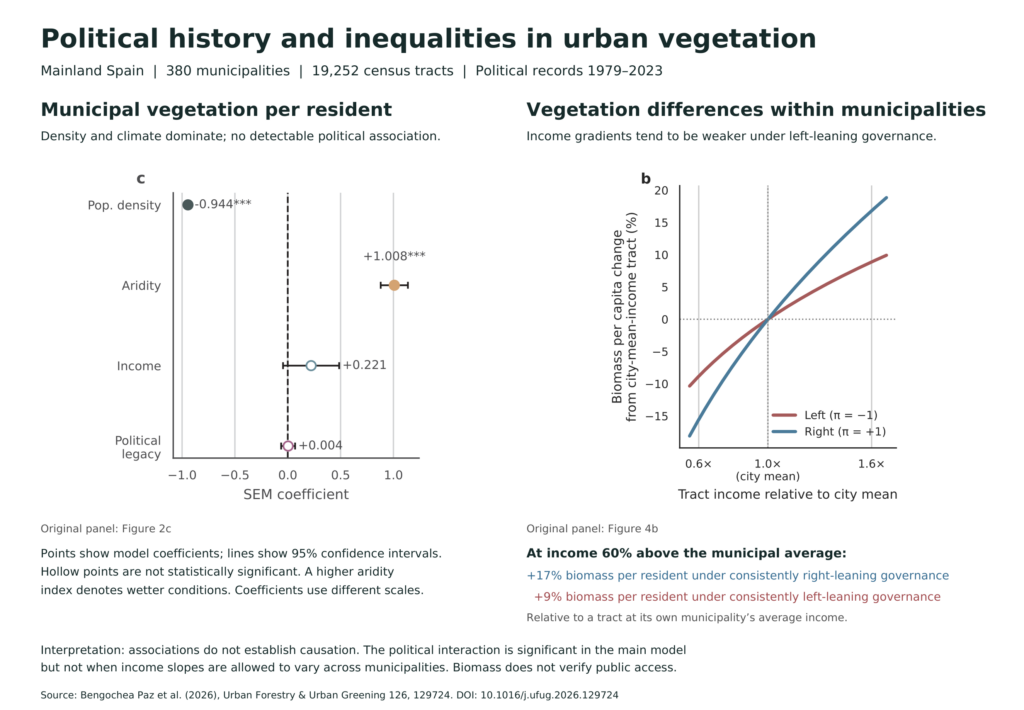
The researchers measured the aboveground woody biomass of trees and shrubs per resident using maps with a resolution of 10 metres. This captures both the extent and structure of woody vegetation, including tree height and canopy volume. At the municipal scale, population density and aridity were the dominant predictors: densely populated and drier municipalities generally held less vegetation per resident.
Within municipalities, income revealed a different pattern. Around 65% of the municipalities analysed showed a positive relationship between neighbourhood income and vegetation per resident after accounting for density and climate. All ten of Spain’s most populous municipalities showed this pattern, with statistically significant relationships in nine.
The study’s main model estimated that a neighbourhood with income 60% above its municipal average would have about 17% more woody biomass per resident than a neighbourhood at the average income under consistently right-leaning governance. The corresponding estimate under consistently left-leaning governance was about 9%. These are model-based comparisons of income gradients, rather than differences in the total vegetation held by left- and right-leaning municipalities.
The authors caution that the study identifies associations and does not establish that political ideology causes the differences. The political association varied substantially across municipalities. It remained in several additional analyses but was no longer statistically significant in a model that allowed the income–vegetation relationship to vary more freely from city to city.
The findings suggest that urban greening strategies should track where vegetation is concentrated as well as how much exists overall. Climate, available land and inherited urban layouts can make large increases in vegetation costly and slow. Targeted street planting, small parks and maintenance in underserved neighbourhoods could offer a more attainable route towards reducing inequalities.
“For climate adaptation, the location of vegetation matters. Municipalities facing tight limits on land and water can still seek to improve conditions in neighbourhoods with less vegetation. The aim should be to bring greening closer to underserved residents while ensuring that they can benefit from it,” says senior author Miguel B. Araújo.
This is important because urban vegetation can provide shade, cooling and everyday contact with nature. However, the study did not directly measure public access, use of green spaces or health outcomes. The authors also stress that greening should be considered alongside housing and social policies, because improvements can raise property values and contribute to displacement of existing residents.
Study details
Authors: Diego Bengochea Paz, Ana Rey, Miguel A. Zavala and Miguel B. Araújo.
Article: Political legacies are associated with urban greening equity but not quantity. Urban Forestry & Urban Greening, volume 126 (2026), article 129724. Published online 3 October 2026.
Article DOI: 10.1016/j.ufug.2026.129724