


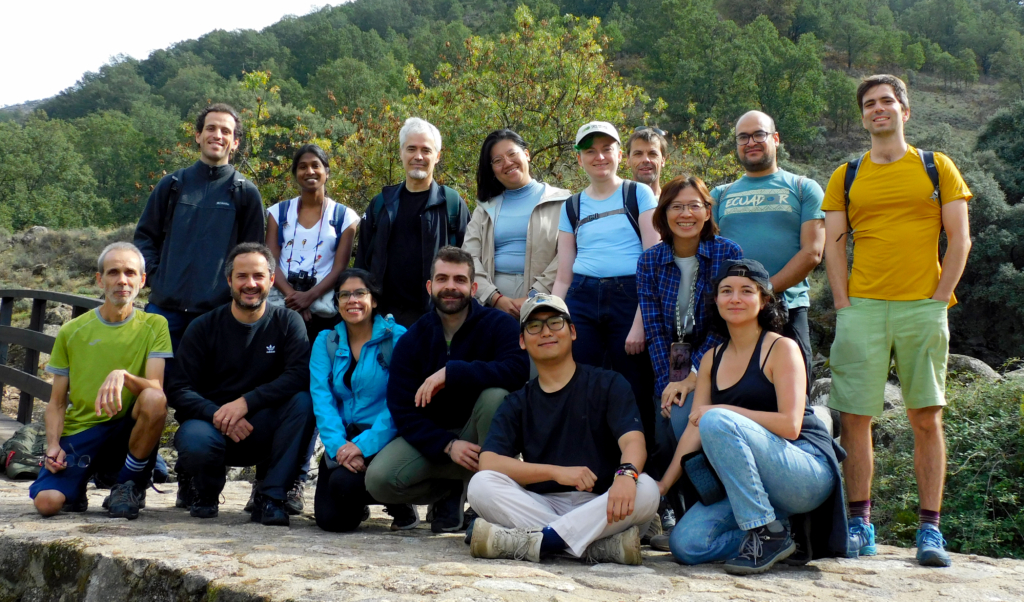
MALPARTIDA DE PLASENCIA, Spain — Seventeen researchers met in northern Extremadura from 18 to 22 October for the group’s 2026 retreat. Over five days they presented and debated sixteen projects on a shared question: how communities, food webs and flows of energy reorganise under global change.
The format favoured debate over delivery. Each talk was capped at 15 to 20 minutes and followed by 40 to 45 minutes of discussion. Researchers travelled from Madrid and Évora to a rural hotel near Malpartida de Plasencia in Cáceres province.
The venue sits between two landscapes that illustrate much of what the group studies. To the south is Monfragüe National Park, 18,396 hectares of quartzite ridges and dehesa, the open oak woodland shaped by centuries of grazing and cork harvesting. It became Extremadura’s first protected area in 1979, after local campaigns against eucalyptus plantations, and a national park in 2007. To the north is the Valle del Jerte, where terraced cherry orchards have replaced much of the former chestnut cover.
I-Ching Chen, a guest from National Cheng Kung University in Tainan, Taiwan, opened the programme on Sunday by challenging the “escalator to extinction”, the idea that warming pushes mountain species uphill until those at the summit run out of room. She cited a review of more than 2,000 species in which near-summit species have largely held their ranges. She also described moths on Mount Kinabalu, in Borneo, that moved uphill between 1965 and 2007 but stopped by 2025 despite continued warming. The absence of local extinctions, she argued, may reflect an extinction debt not yet paid rather than genuine persistence.
Monday’s session on trophic biogeography moved from single species to interactions and energy. Miguel Matías used lake sediments to ask whether human land use has reshuffled freshwater communities among past states or created new ones, and which past restoration should target. Sónika Leconte Ramos presented a metaweb of predator–prey links among European freshwater fish. Pamela González del Pliego tested whether species-saturated bird communities resist newcomers, comparing European atlas data from 1985–1988 and 2013–2017.
Luis Camacho proposed that a trade-off between niche specialisation and energy acquisition should, on its own, produce many low-energy species and few energy-rich ones. Cheongok Jeon outlined a doctoral project on abundance modelling, a field he compared to distribution modelling in the late 1990s. Diego Bengochea proposed redefining the planetary boundary for biosphere integrity by how much wild animal metabolism humans and livestock have displaced. Yi-Wen (Ivory) Chen described global avian biomass pyramids built from 10 to 60 years of surveys covering more than 1,400 species.
Tuesday began with Salvador Herrando-Pérez, who argued from fossil and phylogeographic evidence that the European bison should be considered native or near-native to Iberia. He proposed a stepwise route from controlled herds to free-ranging populations, citing wildfire risk in depopulated landscapes as one reason to act. The group then spent the day on a 16-kilometre hike to the natural pools of Los Pilones, in the Garganta de los Infiernos Nature Reserve, which spans roughly 600 to more than 2,200 metres in elevation.
On Wednesday, a session on ranges, abundances and interactions examined what large-scale indicators miss. Nicolás Merino Roberto showed, across ten ecological networks, that many interactions depend on only a few sites, so a regional network can appear intact while its local support erodes. Yorgos Vagenas presented climate and hydrology projections for more than 4,000 freshwater fish species worldwide. Shahar Chaikin, analysing 137,692 population estimates for 683 marine fish species, found that at the warm edge of their ranges abundance falls faster than biomass, so populations can collapse while their biomass looks stable.
The afternoon turned to conservation practice. Teresa Goicolea Marín described a framework to tell Spanish managers where to act, what to prioritise and which interventions to use under climate change. Diana Buitrago Torres presented an “Orange List” to flag climate risk among about 1,500 taxa not yet considered threatened. Diogo Alagador framed the reassembly of degraded communities as an optimisation problem: which species to return, from where, and in what order when donor populations are scarce.
July Pilowsky closed the scientific programme on Thursday with a case for process-explicit models, which encode dispersal, transmission, reproduction and mortality directly rather than inferring them from correlations. Her example was the house finch and its bacterial pathogen, Mycoplasma gallisepticum. The lab will host an international workshop on the approach this November.
Several themes cut across the sessions. One was that aggregate indicators, such as total biomass, regional network structure or species presence, can conceal the mechanisms driving change. Another was that restoration baselines are choices rather than facts: the past offers many reference states, and selecting one is a decision. A third was the effort to move from correlative patterns toward explicit processes, and from models toward guidance that managers can use.