


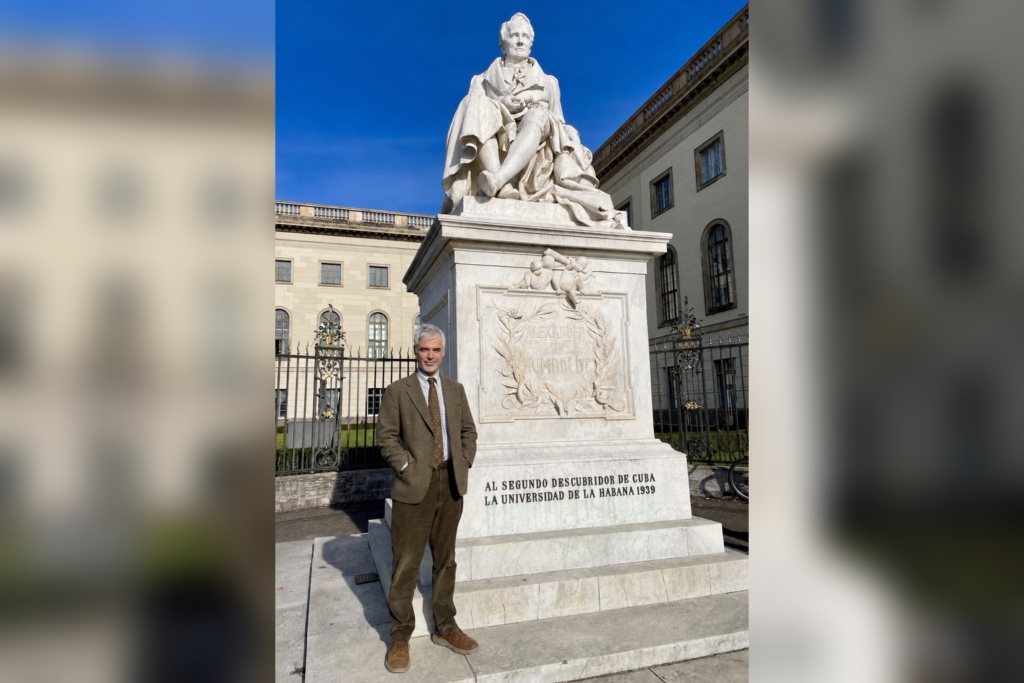
Miguel Araújo beside the statue of Alexander von Humboldt in front of the Humboldt University of Berlin. The inscription, added by the University of Havana in 1939, honours Humboldt as “the second discoverer of Cuba”.
Miguel Bastos Araújo has been granted the A. v. Humboldt – J. C. Mutis Research Award by the Alexander von Humboldt Foundation. The award, worth €80,000, recognises his outstanding accomplishments in research and teaching to date. It is a Humboldt Research Award that also bears the name of the Spanish botanist José Celestino Mutis.
Each year the Foundation gives a number of these awards, across all disciplines, to researchers from abroad in recognition of their work to date. Nominations come from colleagues in Germany, and the award carries an invitation to spend time working with them on a project of the winner’s choice. In this particular case, the award will support a research collaboration with Henrique Pereira’s group at the German Centre for Integrative Biodiversity Research (iDiv) in Leipzig.
For a biogeographer, the name carries a particular weight. Alexander von Humboldt drew one of the founding images of the discipline: his cross-section of the Chimborazo volcano, published with Aimé Bonpland in 1807, which set plants against altitude, temperature and climate in a single picture. In today’s language, it was a map of how species relate to climate. Much of Araújo’s work has been an effort to make that relationship predictive: to forecast how life will rearrange itself as the climate changes, and to state how confident those forecasts can be. His introduction of ensemble forecasting to ecology and the field’s standards for distribution models, which he led, are now routine tools in climate-impact assessments.
“An award that carries Humboldt’s name means a great deal to anyone who studies where life is found and why,” says Araújo. “He was the first to draw the link between climate and the distribution of life. We are still working out its consequences.”
There is also a Spanish thread in the story, and the award’s name carries it. Humboldt’s great American journey began at the Spanish court, which in 1799 granted him passports to travel through its territories in the Americas. In 1801, in Santa Fe de Bogotá, he spent two months with José Celestino Mutis, the Cádiz-born botanist who led the Royal Botanical Expedition to New Granada, and whose botanical collections he greatly admired. More than two centuries later, the connection runs the other way, from a laboratory in Madrid to a research centre in Germany.
Humboldt is remembered for seeing nature as a connected whole; in his diaries he wrote Alles ist Wechselwirkung, everything is interaction. The idea is close to where Araújo’s research has been heading. Over the past decade his group has moved from asking where species live to asking how they interact, how climate shapes the structure of food webs and how energy flows through ecological communities. The time at iDiv will be an opportunity to take these questions in new directions with colleagues in Leipzig.
“Awards like this name one person, but the work behind them never belongs to one person,” Araújo says. “I am grateful to Henrique Pereira for the nomination and the invitation to iDiv, and above all to the students, postdocs and collaborators who built these ideas with me.”
The Humboldt–Mutis award adds to a record that includes the Pessoa Prize, the Rei Jaume I Prize for Environmental Protection, the British Ecological Society’s Marsh Award for Climate Change Research and the Ernst Haeckel Prize of the European Ecological Federation, as well as membership of Academia Europaea and Fellowship of the Linnean Society of London.